



If you’ve searched this question before, you’ve probably read the same advice five times: clean your windows in spring and fall. That advice isn’t wrong, it’s just written for a colder climate than ours.
We started out as window cleaners here in Polk County, so we’ve been answering this exact question for Lakeland homeowners for years. The honest answer looks a little different once you factor in Florida humidity, oak pollen, and the hard water coming out of local sprinklers. Here’s how we think about timing.
Why the “Spring and Fall” Rule Doesn’t Fit Lakeland
Most of the “best time to clean windows” advice online is built around cold-weather climates. The whole point of the 50-to-75-degree rule is to avoid freezing temperatures and to keep cleaning solution from drying too fast in harsh sun. Neither is a real problem here.
Our winters stay mild, with January lows around 50 degrees, so we never worry about a hard freeze fouling up a scheduled cleaning.
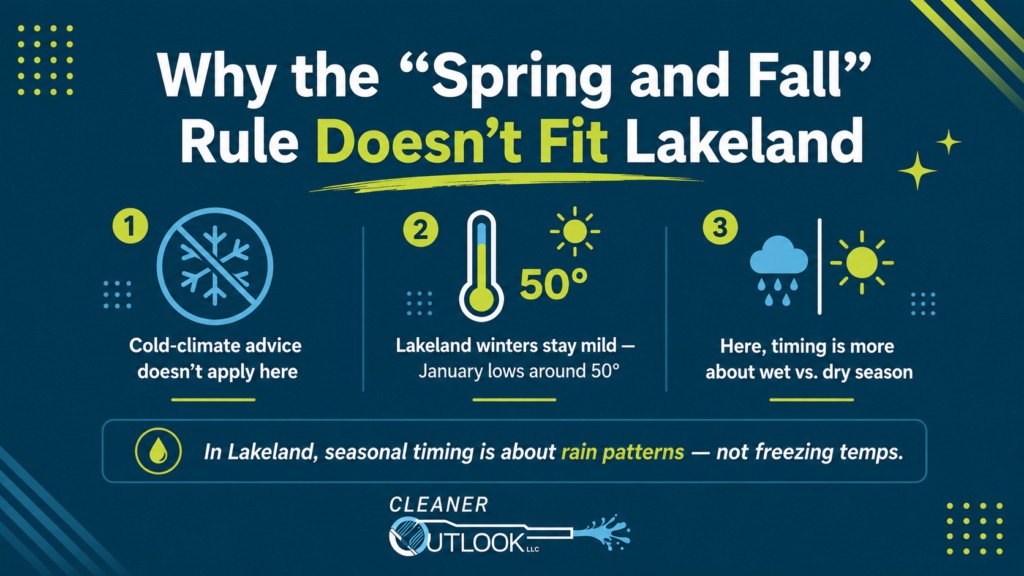
For us, the seasons that matter are wet and dry, not warm and cold. Once you look at it that way, the timing question gets a lot clearer.
The Real Answer: Lakeland’s Dry Season (November Through April)
Lakeland has a genuine wet season and a genuine dry season, and that difference is the whole ballgame for how long your clean windows stay clean. During the dry months, there’s less rain kicking dirt back onto the glass, lower humidity feeding mildew and algae, and more steady sunshine to plan around.
The numbers back it up. December is our driest month, with only about 1.7 inches of rain spread across roughly seven rainy days. August is the opposite, dumping close to 8.7 inches over more than twenty rainy days, with humidity climbing to its yearly peak.
This is also when a lot of seasonal residents and snowbirds get their homes ready, so it’s a natural time to knock the job out. Here’s how the seasons stack up locally.
| Season in Lakeland | Conditions | Best For | Our Take |
|---|---|---|---|
| Winter (Dec–Feb) | Driest and sunniest; December around 1.7 inches of rain; mild highs in the low 70s | Longest-lasting results, holiday and snowbird prep | Prime time. Book here if you only clean once a year. |
| Spring (Mar–Apr) | Still dry with the year’s lowest humidity, but heavy oak pollen | A reset to clear pollen film before summer | Great, especially as a pollen-season refresh. |
| Summer (Jun–Aug) | Rainy season; August near 8.7 inches of rain, high humidity, near-daily storms | Not the ideal window, but workable | Fine with the right method. More on that below. |
| Fall (Sep–Oct) | Storms taper off, humidity starts easing | A second reset before the holidays | A strong second window. Pairs well with roof and gutter work. |
If you want the technical detail behind those figures, the long-term Lakeland climate averages show the same wet-summer, dry-winter pattern year after year. When homeowners ask us for the single best stretch, we point them at the dry season and, more often than not, professional window cleaning in Lakeland during those cooler, drier months. Timing affects the budget too, and we break that down in our guide to what window cleaning costs in Lakeland.
Inside vs. Outside: They’re on Different Clocks
All that dry-season talk really applies to your exterior glass. The outside of your windows takes the beating from rain, pollen, sprinklers, and humidity, so timing matters for how long that side stays clear.
The inside is a different story. Interior glass gets filmy from dust, pet noses, cooking, and the air your AC keeps circulating. That happens year-round and has nothing to do with the weather outside, which means the inside can be cleaned comfortably in any season.
Because interiors don’t care what month it is, the dry season becomes the smart time to do both at once.
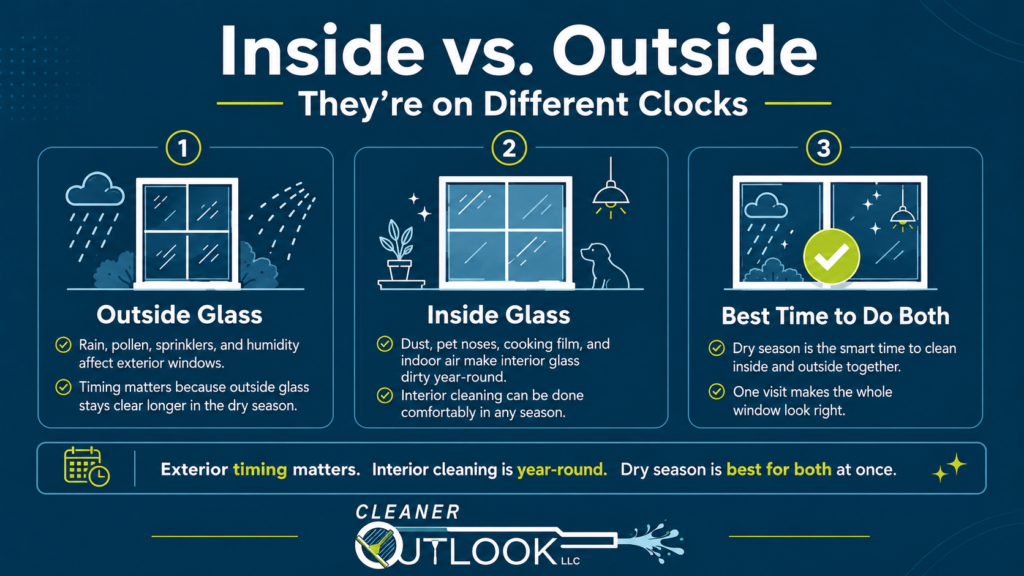
Your exterior clean lasts longer, and the interior gets its periodic refresh in the same visit. We clean both sides in a single appointment, so the whole window looks right, not just the half facing the street.
What Actually Dirties Lakeland Windows (Hint: It’s Not Salt Air)
A lot of the Florida window-cleaning advice online comes from coastal companies, and they lean hard on salt air. That’s a real issue in Naples or Fort Lauderdale. Here in landlocked Polk County, it barely registers. Our culprits are different.
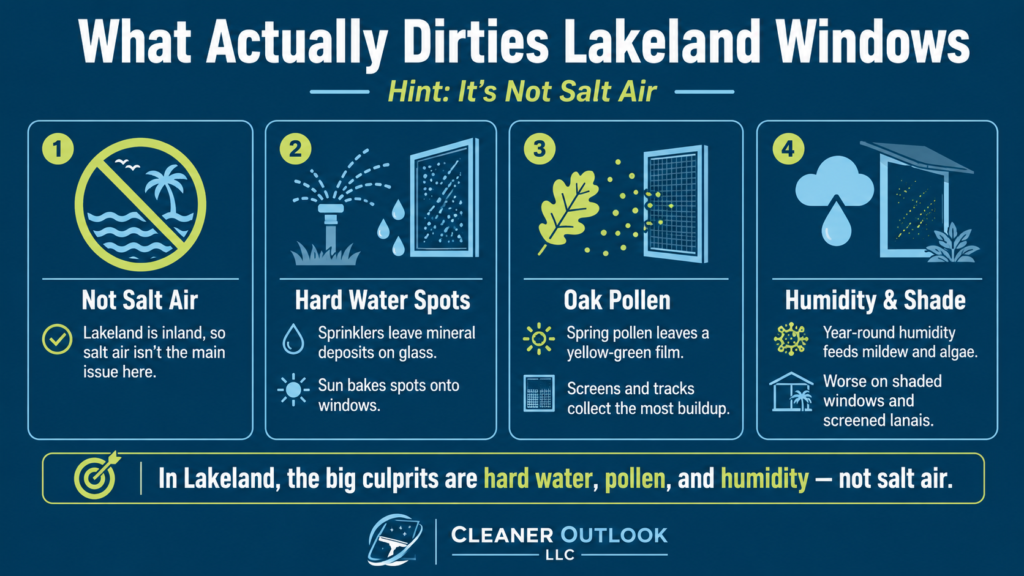
The biggest one is hard water. Central Florida’s water supply, including Polk County, runs high in minerals, and when a sprinkler head catches the side of your house, those minerals dry onto the glass and bake on in the sun. We treat that mineral staining as part of our work, and we’ll walk you through what to expect up front. If spotting has already etched into older glass, we’ll tell you honestly how much we can lift before we start, so you know exactly what you’re getting.
Then there’s oak pollen. Our tree canopy is beautiful and relentless, and every spring it leaves a yellow-green film on glass, frames, and screens. That’s the season we most often add screen and track cleaning, since screens trap the pollen and tracks collect grit. Cleaning those alongside the glass makes the whole window look new instead of just the pane.
Year-round humidity rounds it out, feeding mildew and algae around frames, especially on shaded sides and under screened lanais where debris collects.
How Often Should You Really Clean Your Windows in Lakeland?
For most Lakeland homes, twice a year is the sensible baseline. Homes with more exposure do better on a roughly quarterly schedule. A professional cleaning in our humid climate typically looks its best for one to three months before the elements start showing again, and lower-exposure inland homes stretch toward the longer end of that range.
You don’t have to guess when you’re overdue. Watch for film that shows up when low sun hits the glass at an angle, chalky spots that won’t wipe off with a damp cloth, or dark residue building up in the tracks. Any of those means it’s time.
| Your Home | Recommended Frequency | Why |
|---|---|---|
| Standard inland home, light tree cover | Twice a year | Lower exposure; a dry-season clean plus one reset holds up well |
| Sprinklers hitting the glass, or well water | Every 3–4 months | Mineral spotting builds fast and can etch if left |
| Heavy oak canopy or lakefront lot | Every 3 months | Constant pollen, shade-driven growth, and humidity |
| Screened lanai or pool cage | Every 3–4 months | Debris valleys trap grime and organic growth |
| Storefront or commercial glass | Monthly to quarterly | Curb appeal and foot-traffic film |
You can absolutely wipe down reachable first-floor glass yourself between visits. The case for calling a pro is the part that’s hard to do safely and streak-free: second-story and higher glass, baked-on hard-water spotting, and the outside of screened enclosures. We work up to four stories with water-fed poles and proper safety gear, and if your home goes higher than that, we’ll point you toward a specialist rather than take a risk.
Selling Your Home? Timing Follows the Listing, Not the Calendar
If your home is going on the market, forget the seasonal advice for a minute. The best time to clean is before your listing photos and showings, whatever month that lands in. Clean glass makes photos brighter and rooms feel larger, and those first impressions carry a lot of weight online.
Lakeland gets steady relocation and snowbird buyer traffic, so homes here get toured year-round, including well outside the dry season. If you’re listing in July, don’t wait for December. It also pairs naturally with a house washing so the whole exterior looks its best before the home hits the market. We won’t promise it changes your sale price, but clean windows and a bright first impression never hurt.
Does Rain Ruin a Fresh Window Cleaning? (Why Method Matters More Than the Perfect Week)
This is the fear we hear most: “If it rains right after, did I just waste my money?” The honest answer is no, not the way people imagine. Clean rain falling on already-clean glass doesn’t leave spots the way muddy splash-up from the ground does.

The bigger factor is how the windows were cleaned in the first place. We use a purified water-fed pole system, and purified water dries without leaving mineral spots. We scrub the corners and edges first, then rinse from the top down, so the glass sheets clean and dries clear even in humid conditions. A passing shower afterward won’t undo the work, which is why a steady schedule and the right method beat trying to time a flawless dry spell. We do draw the line at heavy thunderstorms, since that’s a safety issue, and we’ll simply reschedule rather than cut corners in unsafe weather.
Pair Windows With Your Other Dry-Season Exterior Work
The same dry months that suit window cleaning are also prime time for roof cleaning and gutter cleaning, since everything dries and holds up better. Rolling it into one visit saves you a second round of scheduling and disruption.
Bundling several services in one session also saves you money. We take up to 25 percent off when you combine services, and we include a free gutter cleaning with any roof wash, so you handle the whole exterior at once instead of one job at a time. Every quote and every job is performed or personally overseen by our owner, and we’ve been voted a Nextdoor Neighborhood Favorite four years running, so you always know who’s showing up and that the work is held to one standard.
Frequently Asked Questions
What is the best month to clean windows in Lakeland, FL?
December through April is ideal because it’s Lakeland’s dry season, with the least rain and lowest humidity of the year. That gives freshly cleaned glass the best chance to stay spotless longer.
How often should I have my windows cleaned in Central Florida?
Twice a year works for most inland Lakeland homes, while homes with sprinklers on the glass, heavy oak cover, or a screened lanai do better every three to four months. The faster grime comes back, the more often it pays to clean.
Can you clean windows in the summer here?
Yes. We clean year-round, and our purified water-fed pole dries spot-free even in humid conditions. We just reschedule around heavy thunderstorms for safety.
Why do my windows get spotty so fast?
In Polk County it’s usually hard water from irrigation or well systems leaving mineral deposits on the glass. Those spots can etch over time, which is why we set honest expectations before treating older staining.
Should I clean my windows before or after hurricane season?
Both can make sense. A pre-season clean starts you fresh, and a post-season clean clears storm debris and rain spotting. Many Lakeland homeowners simply fold it into their twice-a-year rhythm.
When should I clean my windows if I’m selling my home?
Before your listing photos and showings, no matter the season, since clean glass brightens photos and makes rooms feel larger. With relocation and snowbird buyers touring year-round in Lakeland, it isn’t worth waiting for the dry season.
Do you clean the inside of windows too, or just outside?
We clean both interior and exterior in the same visit. Exteriors follow the seasons, but interiors get filmy from dust, pets, and cooking all year, so pairing them is the efficient choice.
Ready for a Clearer View? Contact us in Lakeland Today
If your windows are due, we’d be glad to take a look. Reach out for a free, no-pressure quote, and we’ll give you honest expectations about what we can do and the best time to do it. Every job is personally handled, and we won’t stop until you’re happy with the results.
Call us at 863-338-6313 or request a quote at cleaneroutlook.com, and let’s get you a cleaner outlook.